
8.1 Why the role matters
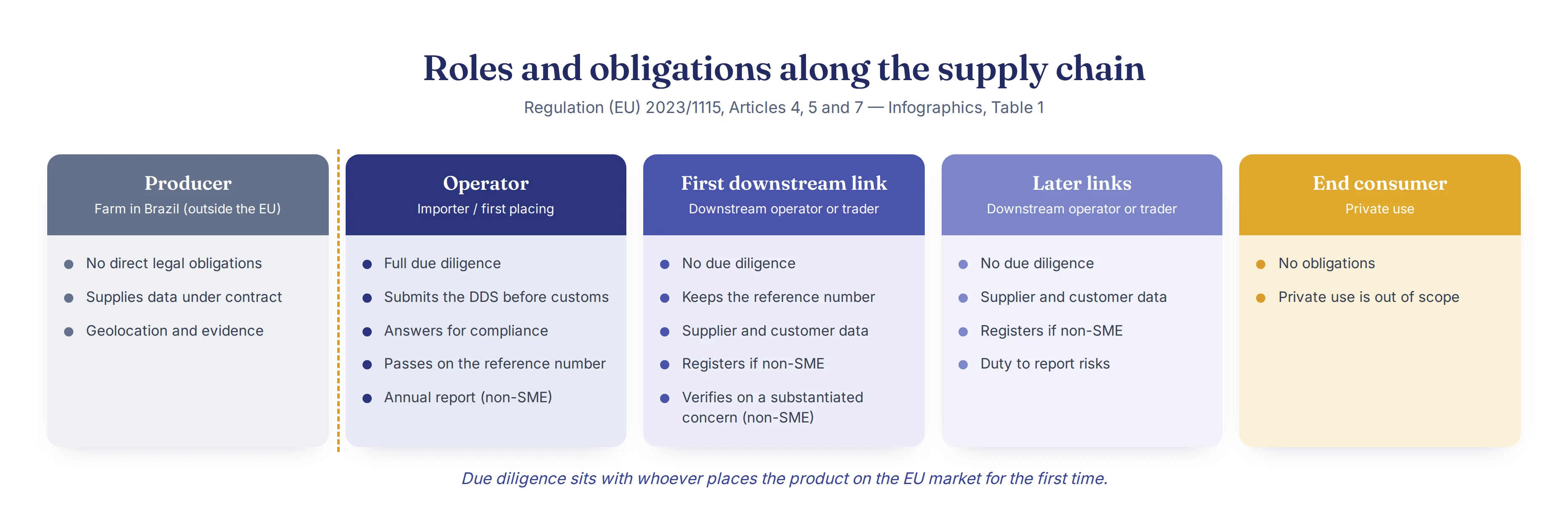
EUDR obligations depend on three variables: the company's role in relation to each product (operator, downstream operator, trader), its position in the chain (first downstream link or a later one) and its size (SME or non-SME). The same company may hold different roles for different products — and even for the same product (Guidance, section 2; FAQ 3.8).
8.2 Operator (the "upstream" operator)
This is whoever first places on the EU market, or exports, a relevant product that has not yet been through due diligence (FAQ 3.1; Infographics, Table 1). It includes:
- importers who declare the product for release for free circulation — the operator is, as a rule, the person shown as the importer in data element 13 04 000 000 of the customs declaration (or box 8, "Consignee", of the single administrative document) — Guidance, section 2.a;
- producers in the EU who first supply the product on the market;
- exporters of products not yet covered by a DDS or a simplified statement.
For imports, the definition of operator does not depend on the transfer of ownership or on contractual arrangements (Guidance, section 2.a). On the internal market, the operator is normally whoever holds the product at the moment of sale; in harvesting or production contracts, it is whoever becomes the owner automatically by the act of producing (judgment C-370/23 of 21/11/2024; FAQ 3.12).
The operator's obligations:
| Obligation | Legal basis |
|---|---|
| Carry out due diligence before placing on the market or exporting | Article 4(1); Article 8 |
| Submit the DDS in the Information System before placing on the market or exporting | Article 4(2) |
| Take on responsibility for the compliance of the product | Article 4(3) |
| Keep a record of the DDS for five years | Article 4(3) |
| Refrain from placing on the market where the product is non-compliant, where the risk is not negligible or where due diligence cannot be completed | Article 4(4) |
| Immediately inform authorities and downstream customers of new information pointing to a risk of non-compliance | Article 4(5) |
| Assist the authorities with checks | Article 4(6) |
| Communicate the DDS reference number to the first downstream operator or trader | Article 4(7) |
| Maintain a due diligence system reviewed annually | Article 12 |
| If a non-SME: publish an annual report, designate a compliance officer at management level and have an independent audit | Articles 11(2) and 12(3) |
Logistics service providers — freight forwarders, shipping agents and customs brokers — with no ownership rights over the products are neither operators nor traders (Guidance, section 2.a; FAQ 2.10 and 3.15).
8.3 Operators established outside the EU (Article 7)
Where an operator from outside the EU places products on the European market, the first person established in the EU who makes them available is also treated as an operator and carries the same obligations. There are then two operators: one outside and one inside the EU (FAQ 3.7). The purpose is to ensure that there is always someone answerable within the Union.
- Operators from outside the EU can only access the Information System if they hold a valid EORI number issued by a Member State (or by the United Kingdom in respect of Northern Ireland). In that case they access it as operators, not as authorised representatives, since representatives must be established in the EU (FAQ 3.7).
- If the EU company does not place a relevant product on the market — for instance, it buys coffee beans and uses them to make coffee-flavoured sweets, which are not in Annex I — Article 7 does not apply to it (FAQ 3.7).
- A consumer buying online from outside the EU is never an operator, even if named as the importer on the customs declaration (FAQ 3.19).
8.4 Micro or small primary operator (MSPO)
Created in 2025, the MSPO is a sub-category of operator with a simplified regime. Four cumulative requirements (FAQ 3.21):
- being a natural person, a microenterprise or a small enterprise under the thresholds of Accounting Directive 2013/34/EU;
- being established in a country classified as low risk;
- placing on the EU market or exporting directly;
- placing on the market products that it produced itself in that country.
Companies above the thresholds may still qualify if they show that the share of the balance sheet, turnover and employees linked to relevant commodities does not exceed two of the three criteria (mixed activity — FAQ 3.25). Natural persons acting in good faith are presumed to be below the thresholds (FAQ 3.26). Size is reassessed each financial year, and a change of category only occurs after two consecutive years above or below the thresholds (FAQ 3.24).
What changes for an MSPO (Article 4a):
- it submits a single simplified statement, with the content of Annex III, and receives a statement identifier;
- it may use a postal address or registry data instead of geolocation, provided they clearly correspond to the plots or to the establishment (FAQ 3.28);
- it does not need to submit a statement at all where all the Annex III information is already held in a national or EU public database and the Member State makes it available in the system;
- it still has to carry out due diligence (the information gathering of Article 9 and the system of Article 12) but, since it sources only in a low-risk country, it does not have to run risk assessment and mitigation, unless information pointing to risk emerges (Guidance, section 4.c);
- it may update the statement after a substantial change, and must submit a new one if it starts placing entirely new products on the market (FAQ 3.27);
- it may declare several commodities and several plots in a single statement (FAQ 3.29).
Cooperatives can be MSPOs where they produce themselves; or they may act as authorised representatives of their members, if established in the EU (FAQ 3.20 and 3.22). One person may be an MSPO for what they produce and an ordinary operator for what they import (FAQ 3.23).
8.5 Downstream operator
This is whoever places on the market or exports a relevant product made from other relevant products already covered by a DDS or a simplified statement (Article 2, point 15b). Typically there is a change of CN code: green coffee (0901 11) roasted (0901 21); soybeans (1201) crushed into meal (2304) and oil (1507); logs (4403) sawn (4407) — FAQ 3.1.1.
Whoever exports a product already covered by a DDS is also a downstream operator, even without transforming it (FAQ 5.6.1).
Important: whoever imports a derived product from a third country — wooden furniture, say — is an operator, not a downstream operator, because the product is not yet covered by a DDS (Infographics, Table 4). And whoever re-imports a product exported from the EU is a downstream operator only if able to prove that it had already been placed on the EU market with due diligence (FAQ 5.4).
8.6 Trader
This is whoever makes a relevant product available on the market without being an operator or a downstream operator — reselling without transforming, keeping the same CN code (FAQ 3.1.1). Retailers, wholesalers and distributors usually sit here, but a retail chain may be an operator (if it imports) or a downstream operator (if it transforms), depending on the case (FAQ 3.9).
8.7 Downstream obligations side by side
Downstream operators and traders have the same obligations (Article 5; Infographics, Table 4). They vary with position and size:
| Obligation | First downstream — non-SME | First downstream — SME | Later link — non-SME | Later link — SME |
|---|---|---|---|---|
| Carry out due diligence / submit a DDS | No | No | No | No |
| Register in the Information System (Article 5(2)) | Yes | No | Yes | No |
| Collect and keep supplier and customer data for 5 years (Article 5(3) and (4)) | Yes | Yes | Yes | Yes |
| Collect and keep DDS reference numbers / identifiers (Article 5(3)(a)) | Yes | Yes | No | No |
| Inform authorities and customers of indications of non-compliance (Article 5(5)) | Yes | Yes | Yes | Yes |
| Verify that due diligence was carried out, in the event of a substantiated concern (Article 5(6)) | Yes | No | Yes | No |
| Responsible for the compliance of the product (Article 3) | No | No | No | No |
| Annual public report | No | No | No | No |
Source: Infographics, Table 1; FAQ 3.4 to 3.6.2.
Details that make a difference:
- The first downstream link does not have to ask whether the supplier is an operator. It may presume in good faith that the supplier is not, if no reference number arrives; it must refrain only if it knows the supplier is an operator and failed in its duty to pass the number on (FAQ 3.4 and 3.5).
- "Collect and keep" requires no specific system and no systematic checking of the validity of the numbers: it is enough to be able to retrieve and compile the information within a reasonable time at the authority's request (FAQ 3.4, b).
- The reference numbers must be linked to incoming flows, not to outgoing ones (FAQ 3.4, b).
- The verification under Article 5(6) is reactive: it is triggered only by a substantiated concern. It can be done by checking the validity and content of the DDS in the system, consulting the supplier's public reports and audits or the country list, or asking for information; where that is impossible, by providing the authority with the chain data (FAQ 3.6.2).
- The operator is not obliged to pass on the DDS verification number, nor the geolocation; it may grant sight of the geolocation to non-SME operators and traders holding both the reference and the verification number (FAQ 3.6 and 3.6.1; FAQ 7.7).
8.8 Special cases of roles
Dual role. A company that imports logs and saws them within the same legal entity is an operator (on import) and the first downstream operator (on the sale of the sawn wood); it does not have to pass the import DDS number to the customer. If it uses wood it harvested itself, it is an operator for the sawn wood and must pass the number on (FAQ 3.8; Infographics, Scenarios 5 and 7).
Groups of companies. Each legal entity is assessed individually, including for size. Each needs its own account in the system; the group may appoint one member established in the EU as authorised representative for all of them (FAQ 3.13 and 5.3).
E-commerce. The rules apply equally to B2B and B2C. Marketplaces that merely act as intermediaries have no obligations; whoever actually supplies the product (the seller, the online retailer or the fulfilment provider) does (FAQ 3.17 to 3.19).
Outsourced outlets. In coffee shops or kiosks inside supermarkets, the responsible party is whoever buys the product and supplies it to the customer, according to the contract (FAQ 3.14).
Authorised representative vs customs broker. Distinct functions, under distinct mandates. A customs broker is never an operator (FAQ 3.15).
8.9 Authorised representatives (Article 6)
- Any operator may appoint an authorised representative to submit a DDS or a simplified statement on its behalf; responsibility for compliance remains with the operator.
- The representative must be established in the EU and hold a written mandate; it must produce a copy of the mandate to the authorities on request, in an official EU language and in that of the Member State where the statement is handled (or in English).
- An operator that is a natural person or a microenterprise may appoint as its representative the next link in the chain, provided that link is neither a natural person nor a microenterprise; that link may not place the product on the market without having submitted the statement on the operator's behalf.
- In the system, the representative registers under the role "Representing Operator" and may represent several operators (FAQ 5.2.1).
- Any person established in the EU may act as representative — including cooperatives, associations and national authorities that are not EUDR competent authorities.