
28.1 What the FAQ is — and what it is not
The Frequently Asked Questions on the implementation of the EUDR are a working document of the European Commission's services. The version used throughout this guide is version 5, of April 2026, which incorporates the amendments introduced by Regulation (EU) 2025/2650 of December 2025 — among them the new supplier role and the rules for submitting the due diligence statement and the simplified declaration.
What it is not: it is not law, it binds no one legally and it does not replace the Regulation. The final interpretation of any provision rests with the Court of Justice of the European Union. The document presents itself as non-binding guidance.
What it is, in practice: the text competent authorities, European importers and auditors turn to when the Regulation and the Guidance Document do not answer the operational question. A Brazilian exporter who ignores the FAQ is not breaking the law — they are simply out of step with what their buyer will require in the contract and with what the authority will look for on inspection.
The FAQ changes. Version 4 is from April 2025; version 5 from April 2026. Items are added, rewritten and renumbered between editions, and revised answers are flagged as updated. Any internal procedure that cites an item number must also record the version consulted and the date.
28.2 The ten sections of FAQ version 5
Version 5 groups the questions into ten sections. The titles below are those of the official document, with an indication of where each topic is covered here.
| Section | Official title | What it covers | In this guide |
|---|---|---|---|
| 1 | Traceability | Geolocation, polygons, mixing, silos, segregation, declaration in excess | Chapter 11 and this chapter |
| 2 | Scope | Which products and CN codes are covered and which fall outside | Chapter 6 |
| 3 | Subjects of obligations | Operator, trader, downstream operator, authorised representative, supplier, SMEs | Chapters 8 and 15 |
| 4 | Definitions | Forest, degradation, agricultural use, production, placing on the market | Chapters 4 and 5 |
| 5 | Due Diligence | Information collection, risk assessment and mitigation, DDS, customs | Chapters 9, 10 and 14 |
| 6 | Benchmarking and partnerships | Country risk levels, review of the list, international cooperation | Chapter 20 |
| 7 | Digital implementation (the EUDR Information System) | TRACES, registration, DDS submission, API, geolocation files | Chapter 14 |
| 8 | Timelines | Application dates, transitional regime, goods produced before 29/06/2023 | Chapter 16 |
| 9 | Other questions | Certification, analysis tools, interaction with other rules, open data | Chapters 13, 22 and 25 |
| 10 | Penalties | Types of penalty, proportionality, repeat offences, publicity of decisions | Chapter 18 |
For the Brazilian grain chain the weight is not evenly spread. Section 1 holds almost everything that decides whether a shipment is accepted; section 3 decides who signs what; section 8 decides whether a given crop year is in or out.
28.3 The items that weigh most for Brazilian soy
| Item | What it covers | Why it weighs here |
|---|---|---|
| 1.1 | Geolocation is mandatory for every product, with no exception by country risk level | There is no shortcut for Brazil on the grounds of standard risk |
| 1.3 and 1.5 | Compliant means 100% traceable to the plot, legal, deforestation-free and never mixed with goods of unknown origin | Sets the acceptance criterion for every load received |
| 1.4 | Mass balance is not accepted | Rules out the credit-based certification model used in other chains |
| 1.16 | A central point with a radius does not replace a polygon | Invalidates legacy databases built around farm headquarters |
| 1.17 | How to declare the place of production of goods mixed in a silo | It is the rule that governs every collective warehouse in Brazil |
| 1.18 | When more plots than those shipped may be declared, and at what cost | Sets the limit and the price of what 1.17 requires |
| 3.7 | A non-EU exporter is not an operator unless it places the product on the EU market | Decides who submits the DDS in the relationship with the buyer |
| 8.3 | Goods produced before 29/06/2023 fall outside | Requires documentary proof of the production date, not the shipment date |
28.4 The problem rule 1.17 solves
Brazilian soy does not travel in labelled bags. It is harvested on many farms, weighed on a warehouse scale, tipped into a pit, dried, and disappears into a silo cell that already holds other producers' grain. What leaves on the truck or on the conveyor to the port is a physical mixture whose composition nobody can reconstruct grain by grain.
The Regulation, however, requires the geolocation of the plot where the commodity was produced (Art. 9(1)(d)). Applied to the letter and nothing more, that requirement would make it impossible to declare any volume coming out of a collective warehouse — or, worse, would push the market towards the wrong answer: declaring a handful of farms whose tonnage matches the shipment and hoping no inspector asks.
Rule 1.17 is the Commission's answer to that impasse. It does not ask for the physical mixture to be reconstructed. It moves the question: instead of “which farm did this grain come from?”, it asks “which farms could have contributed to this shipment?” — and requires all of them to be declared.
28.5 The rule, in its two forms
The starting point is a single sentence: the operator must declare the place of production of all goods effectively shipped to the EU. When compliant goods from several places of production are mixed into the same silo, stack, pile, tank or similar and only part of them is placed on the EU market, the FAQ offers two routes.
- Silos emptied regularly. Declare the place of production of everything that entered the silo since it was last empty — because any of those intakes could, in principle, be in the shipment.
- Silos not emptied regularly. Declare the place of production of everything that entered over a period that ensures no commodity of unknown place of production was mixed into the process. The FAQ recognises as a safe approach, when drawing down part of what is stored, declaring the geolocation of all previous goods that entered the silo up to a minimum of 200% of the silo's capacity, provided it operates on a first-in first-out (FIFO) basis or an equivalent system ensuring the chronological exhaustion of raw materials in the order of their entry.
The FAQ is explicit about reach: the same approach applies to commodities stored in stacks, tanks and the like, and to all continuous processing. And it leaves the door open: other approaches are possible, both for FIFO and for other storage systems, as long as they ensure that commodities of unknown origin or non-compliant with the EUDR are not mixed into the process.
28.6 Why 200%, and not 100%
This is the question everyone asks, and it deserves an honest record: the FAQ does not demonstrate the figure. It presents 200% as a safe way to proceed, not as the result of a physical calculation of mixing.
This guide reads the margin as follows. Under perfect FIFO, what sits inside the silo at any moment corresponds to the most recent intakes up to the limit of its capacity — 100% would do. But perfect FIFO does not exist in a grain warehouse: there are dead zones, recirculation through the dryer, transfers between cells, mixing in the pit, bottom residue and recording error. Requiring twice the capacity gives one whole capacity of slack for those imperfections. It is an administrative safety margin, not a measure of diffusion.
Two practical consequences follow. First, 200% is a floor, not a ceiling — the text says “a minimum of”. A silo with poor FIFO requires more, and whoever knows the operation knows this better than any auditor. Second, anyone who can prove periodic emptying escapes the 200% rule and declares a far shorter window. The economic incentive points towards emptying and recording.
28.7 A worked example
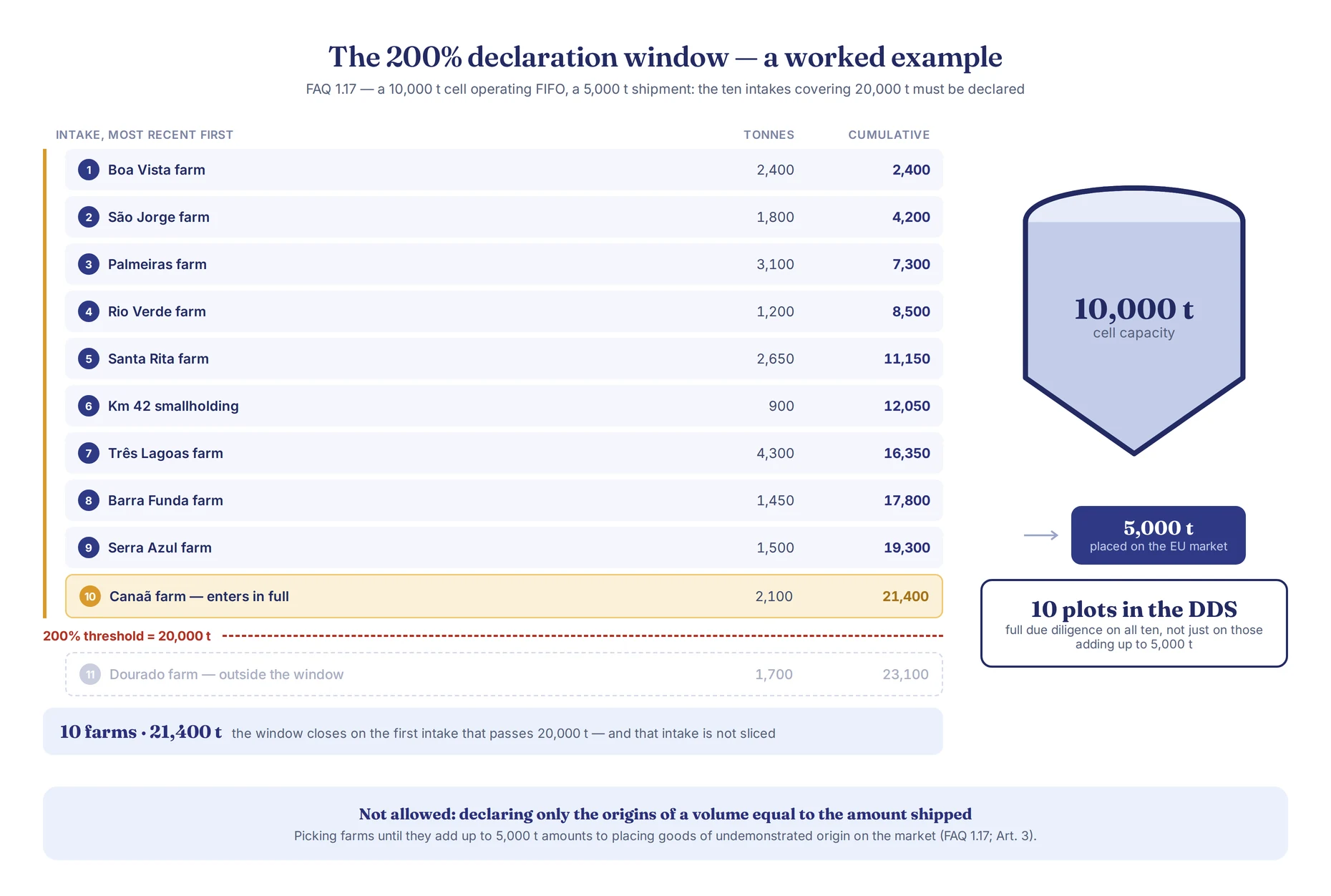
A 10,000 t cell that is not emptied regularly, operating documented FIFO. The target for the declaration window is 200% of capacity, that is, 20,000 t of intakes counted from the most recent backwards.
| # | Intake (most recent first) | Tonnes | Cumulative | In the declaration? |
|---|---|---|---|---|
| 1 | Boa Vista farm | 2,400 | 2,400 | Yes |
| 2 | São Jorge farm | 1,800 | 4,200 | Yes |
| 3 | Palmeiras farm | 3,100 | 7,300 | Yes |
| 4 | Rio Verde farm | 1,200 | 8,500 | Yes |
| 5 | Santa Rita farm | 2,650 | 11,150 | Yes |
| 6 | Km 42 smallholding | 900 | 12,050 | Yes |
| 7 | Três Lagoas farm | 4,300 | 16,350 | Yes |
| 8 | Barra Funda farm | 1,450 | 17,800 | Yes |
| 9 | Serra Azul farm | 1,500 | 19,300 | Yes |
| 10 | Canaã farm | 2,100 | 21,400 | Yes — this is the intake that crosses 20,000 |
| 11 | Dourado farm | 1,700 | 23,100 | No — the window has closed |
A 5,000 t shipment drawn from that cell therefore requires the geolocation of ten farms, corresponding to 21,400 t of intakes. Two details usually slip past:
- The intake that crosses the line is not sliced. Canaã farm enters in full, with all its plots. Declaring 700 t out of its 2,100 t would be a return to exactly the error the rule forbids.
- The window belongs to the silo, not to the shipment. Ten farms declared for 5,000 t shipped is neither excess nor generosity: it is the size of the physical uncertainty the mixing created.
28.8 What is expressly forbidden
The same reasoning knocks down three variations on the idea: picking the farms “closest” to the shipped volume, picking those with the cleanest registry status, or running a weighted draw among the suppliers of the period. All of them assume a correspondence between grain and plot that the mixing destroyed.
28.9 The risk arithmetic
Rule 1.17 has an effect that is rarely measured before the first audit: it multiplies the risk surface. In the example above, ten farms come to answer for a 5,000 t shipment, and one of them being irregular is enough to contaminate the whole set (FAQ 1.18). Full due diligence — valid polygon, geospatial analysis, legality file, indirect supplier check — has to be done for all ten, not for the two or three that would add up to the volume.
Hence the economic reading of the rule: everything that shortens the window cuts risk and cost. Empty and record it; dedicate cells to audited suppliers; physically segregate EU-bound soy from the rest; block at intake any load without an approved polygon. These are operating decisions, not paperwork.
28.10 Relationship with FAQ 1.18 — declaration in excess
The two rules are the same problem seen from opposite sides. 1.17 requires more plots to be declared than were physically shipped; 1.18 says when that is allowed and what it costs.
Declaration in excess is admitted in two situations: bulk commodities fully traced to the plot and never mixed with goods of unknown origin, combined in silos, ships or mills, where only part of the whole is placed on the market; and crop rotation across a set of fields on the same farm, where soy moves between areas each year. The consequences are heavy: the operator assumes full responsibility for every plot declared, used or not; one non-compliant plot renders the entire set non-compliant; and full due diligence has to be exercised over all of them.
There is a clear limit on the other side: declarations in excess at regional or national scale — “every farm in the municipality”, “the whole state registry” — are generally not compliant with the Regulation, because they would prevent circumvention risk from being mitigated and the authorities from enforcing. The detail is in Chapter 11, section 11.6.
28.11 Crushing and continuous processing
The FAQ extends the same logic to all continuous processing — and soybean crushing is the Brazilian case par excellence. The plant receives grain from several origins, feeds the process without interruption and produces meal and oil in a flow. There is no such thing as “the batch of meal from Farm X”.
Here the window is built on the feed into the process: the plots to declare for a lot of meal are those of the grain intakes that fed the plant over the corresponding period, on the same criterion of emptying or of 200% of the capacity of the silos supplying the line. Whoever runs a small buffer silo with fast turnover has a short window; whoever runs a large silo with slow turnover has a long one — and more suppliers to audit per tonne exported.
28.12 What to keep as evidence
| Evidence | What it is for | Minimum period |
|---|---|---|
| Intake log per cell, with date, supplier, weight and invoice | Builds the declaration window and proves the chronological order | 5 years (Art. 9(1)) |
| Emptying record or cleaning report per cell | Unlocks the first route and shortens the window | 5 years |
| Written description of the FIFO regime and of the flows between cells | Supports the premise of chronological exhaustion | While in force, and 5 years after |
| Nominal capacity certificate for each cell | Fixes the basis for the 200% calculation | 5 years |
| Polygon and legality file for every supplier in the window | Due diligence over all declared plots | 5 years (Art. 12(5)) |
| Contractual clause granting access to the third-party warehouse's intake records | Makes the window possible when the silo is not your own | Term of the contract, and 5 years after |
28.13 Seven common mistakes
| # | Mistake | What to do instead |
|---|---|---|
| 1 | Declaring farms until they add up to the volume shipped | Build the window from emptying or from 200% of capacity (FAQ 1.17) |
| 2 | Treating 200% as a ceiling | Read it as a floor and widen it where FIFO is imperfect |
| 3 | Calculating the window on the shipment volume | Calculate it on the nominal capacity of the cell |
| 4 | Slicing the intake that crosses the 200% line | Include the whole intake, with all its plots |
| 5 | Claiming the silo was emptied with nothing on file | Keep a dated report, level reading or fumigation order |
| 6 | Running due diligence only on the “main” farms in the window | Run it on every declared farm — one irregular plot contaminates the set (FAQ 1.18) |
| 7 | Storing with third parties without a clause on access to intake records | Put the clause in before the crop year, not on the eve of shipment |